|
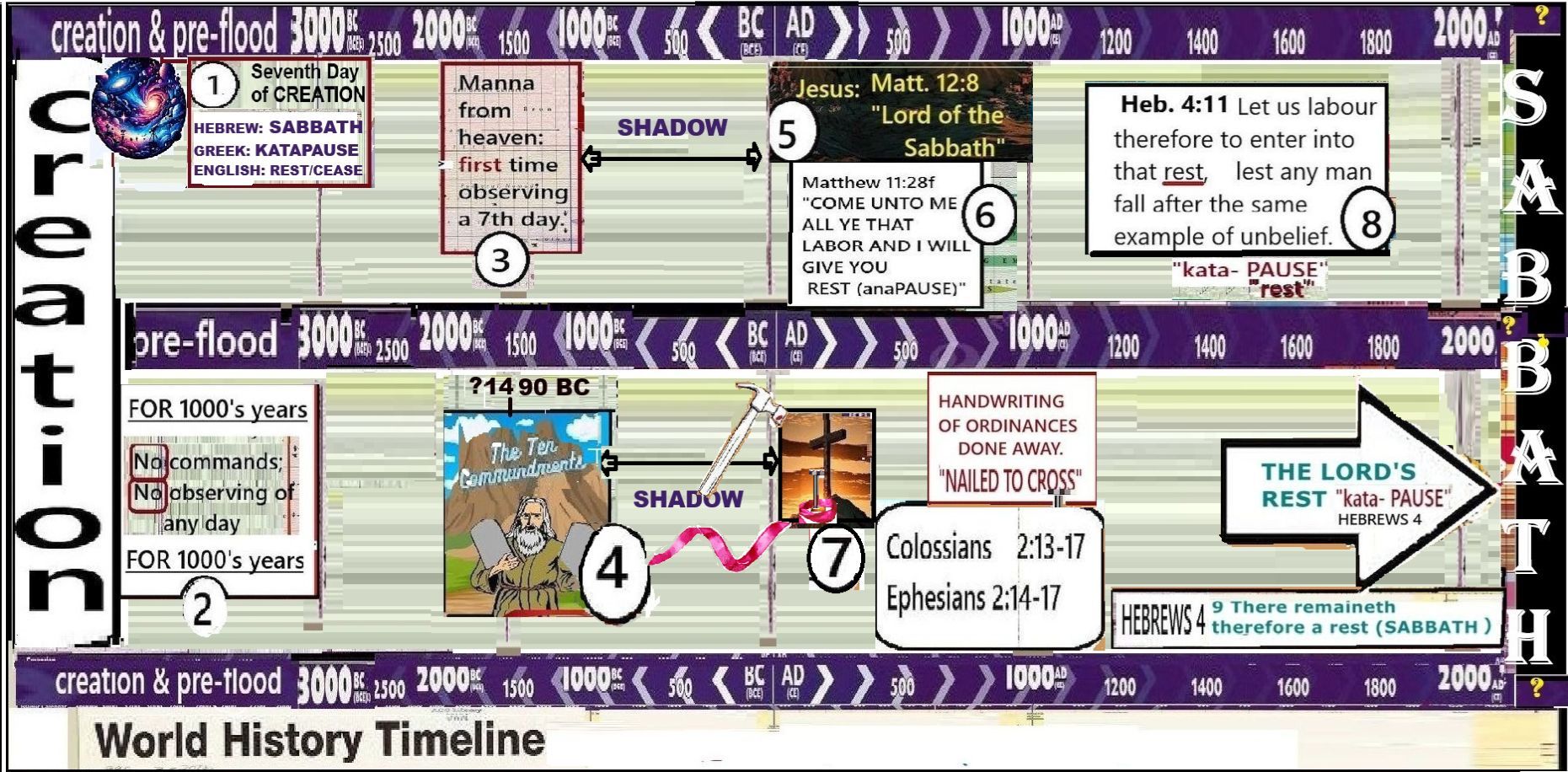
① Genesis 2:2,3. NOTICE: Click/tap twice for underlined references. Once, to hide. God made the seventh day holy and blessed it because He rested (Greek: kata-pause) from the activity of creation. No instructions are recorded for Adam and Eve on it.
Genesis 2: 2 And on the seventh day God ended his work which he had made; and he rested on the seventh day from all his work which he had made. 3 And God blessed the seventh day, and sanctified it: because that in it he had rested from all his work which God created and made
"rest"
Abbott-Smith's Manual Greek Lexicon of the New Testament
Strong's #G2664
[in LXX for H5117 (nuach), H7673 (shabath), etc.;]
1. trans.,
(a) to cause to cease, restrain: Act 14:18;
(b) to cause to rest: Heb 4:8.
2. Intrans., to rest: Heb 4:4 (LXX), Heb 4:10. |
② No commands are given and there is no observing of a special sabbath day on the seventh or any other day. This is obvious from the Bible text and from Gentile records of history. This is true for the time before the flood and for a thousand years after the flood.
③ The first evidence of a command and observing the seventh day as a sabbath rest is the collections of manna from heaven during Israel's exodus from Egypt. The people are to collect the food every day of the week exept on the Sabbath day. On the sixth day Friday they collect food for 2 days so that they will rest from collecting on the seventh.
Exodus 16:4, 5, 29fExodus 16: 4 Then said the LORD unto Moses, Behold, I will rain bread from heaven for you; and the people shall go out and gather a certain rate every day,
that I may prove them, whether they will walk in my law, or no. 5 And it shall come to pass, that on the sixth day they shall prepare that which they bring in; and it shall be twice as much as they gather daily.
29 See, for that the LORD hath given you the sabbath,
therefore he giveth you on the sixth day the bread of two days; abide ye every man in his place, let no man go out of his place on the seventh day. 30 So the people rested on the seventh day.
|
④ The Ten Commandments in the Law of Ordinances given through Moses contain the first specific observance of a seventh day sabbath followed later with monthly sabbath days. This was exclusively given to rescued Israel and was bound on whoever resided in their country. But no Gentiles living outside of Israel were expected to honor this day; e.g., Assyria and Babylon.
Sabbath is a sign between God and Israel: Exodus 31:14-17;
| Exodus 31:14-17 "
14 Ye shall keep the sabbath therefore; for it is holy unto you: every one that defileth it shall surely be put to death: for whosoever doeth any work therein, that soul shall be cut off from among his people. 15 Six days may work be done; but in the seventh is the sabbath of rest, holy to the LORD: whosoever doeth any work in the sabbath day, he shall surely be put to death.4
16 Wherefore the children of Israel shall keep the sabbath, to observe the sabbath throughout their generations, for a perpetual covenant.
17 It is a sign between me and the children of Israel for ever: for in six days the LORD made heaven and earth, and on the seventh day he rested, and was refreshed." |
| Deuteronomy 5:2 The LORD our God made a covenant with us in Horeb. 3 The LORD made not this covenant with our fathers, but with us, even us, who are all of us here alive this day. |
| Deuteronomy 5:14 But the seventh day is the sabbath of the LORD thy God: in it thou shalt not do any work, thou, nor thy son, nor thy daughter, nor thy manservant, nor thy maidservant, nor thine ox,
nor thine ass, nor any of thy cattle, nor thy stranger that is within thy gates; that thy manservant and thy maidservant may rest as well as thou. 15 And remember that thou wast a servant in the land of Egypt, and that the LORD thy God brought thee out thence through a mighty hand and by a stretched out arm: therefore the LORD thy God commanded thee to keep the sabbath day. |
Jonah 3:
8 But let man and beast be covered with sackcloth, and cry mightily unto God: yea, let them turn every one from his evil way, and from the violence that is in their hands. 9 Who can tell if God will turn and repent, and turn away from his fierce anger, that we perish not?
10 And God saw their works, that they turned from their evil way; and God repented of the evil,..."
Assyria had done evil; they repented. It wasn't because of any sabbath keeping failure. |
⑤ Jesus keeps the Law covenant given through Moses and He fulfils it ( Matthew 5:17)
| Matthew 5:17 Think not that I am come to destroy the law, or the prophets: I am not come to destroy, but to fulfil. |
| Matthew 12: 2 But when the Pharisees saw it, they said unto him, Behold, thy disciples do that which is not lawful to do upon the sabbath day.
... 5 (Jesus:) Or have ye not read in the law, how that on the sabbath days the priests in the temple profane the sabbath, and are blameless? 6 But I say unto you, That in this place is one greater than the temple. 7 But if ye had known what this meaneth, I will have mercy, and not sacrifice, ye would not have condemned the guiltless. 8 For the Son of man is Lord even of the sabbath day. |
⑥ Jesus affirms that He offers the true rest (sabbath; "anapausis"). Come unto me... and I will give you rest.
Matthew 11:28-29.
Matthew 11:28 Come unto me, all ye that labour and are heavy laden, and I will give you rest. 29 Take my yoke upon you, and learn of me; for I am meek and lowly in heart: and ye shall find rest unto your souls.
G373 ana-pauo (a-na-pav'-o)(English: pause) v.
1. (reflexively) to repose, to rest.
2. (literally or figuratively) to be exempt, to remain.
3. (by implication) to refresh.
|
⑦ The Law of Ordinances that are dividing against the Gentiles, etc., concludes at the cross. A new covenant is in force after the cross. (Colossians 2 and Ephesians 2).
Colossians 2:13-17
|
COLOSSIANS 2
13
And
you, being dead in your sins and the uncircumcision*
of your flesh, hath he quickened together with him, having forgiven
you all trespasses;
14 Blotting
out the handwriting of ordinances that was against us,*
which was contrary to us, and took it out of the way, nailing it to
his cross;
15 And
having spoiled principalities and powers, he made a shew of them
openly, triumphing over them in it. 5
*uncircumcised us: Colosssians (Gentiles).
16
Let
no man therefore judge you in meat, or in drink, or in respect of an
holyday, or of the
new moon, or of the sabbath G4521*
days:
[italicized because not in Greek text--GW]17 Which
are a shadow of things to come; but the body (other translations:
“substance”) is
of Christ.
|
Ephesians 2:14-20
|
Ephesians 2: 14 For he is our peace, who hath made both one, and hath broken down the middle wall of partition between us; 15 Having abolished in his flesh the enmity, even the law of commandments contained in ordinances; for to make in himself of twain one new man, so making peace; 16 And that he might reconcile both unto God in one body by the cross, having slain the enmity thereby:4 17 And came and preached peace to you which were afar off, and to them that were nigh. 18 For through him we both have access by one Spirit unto the Father. 19 Now therefore ye are no more strangers and foreigners, but fellowcitizens with the saints, and of the household of God; 20 And are built upon the foundation of the apostles and prophets, Jesus Christ himself being the chief corner stone; |
|
Hebrews 9:15 And for this cause he is the mediator of the new testament, that by means of death, for the redemption of the transgressions that were under the first testament,The Law of Moses-Old Testament they which are called might receive the promise of eternal inheritance. 16 For where a testament is, there must also of necessity be the death of the testator. 17 For a testament is of force after men are dead: {hence, the cross is the dividing timeline} otherwise it is of no strength at all while the testator liveth.
|
⑧ God offers the true and abiding and eternal sabbath reserved for true believers (Hebrews 3,4).
Hebrews 3:9 ...-4: 2
;
|
Heb. 3:9 When your fathers tempted me, proved me, and saw my works forty years. 10 Wherefore I was grieved with that generation, and said, They do alway err in their heart; and they have not known my ways. 11 So I sware in my wrath, They shall not enter into my rest. [Greek: kata-paus same as Gen.2) 12 Take heed, brethren, lest there be in any of you an evil heart of unbelief, in departing from the living God.
18 And to whom sware he that they should not enter into his rest (Greek: kata-paus cf. Gen.2), but to them that believed not? 19 So we see that they could not enter in because of unbelief. Hebrews 4: 1 Let us therefore fear, lest, a promise being left us of entering into his rest, any of you should seem to come short of it. 2 For unto us was the gospel preached, as well as unto them: but the word preached did not profit them, not being mixed with faith in them that heard it.
|
Hebrews 4:3 For we which have believed do enter into rest, as he said, As I have sworn in my wrath, if they shall enter into my rest: although the works were finished from the foundation of the world. 4 For he spake in a certain place of the seventh day on this wise, And God did rest the seventh day from all his works. 5 And in this place again, If they shall enter into my rest. 6 Seeing therefore it remaineth that some must enter therein, and they to whom it was first preached entered not in because of unbelief: 7 Again, he limiteth a certain day, saying in David, To day, after so long a time; as it is said, To day if ye will hear his voice, harden not your hearts. 8 For if Jesus had given them rest, then would he not afterward have spoken of another day. 9 There remaineth therefore a rest*see rest below to the people of God. 10 For he that is entered into his rest, he also hath ceased from his own works, as God did from his.
11 Let us labour therefore to enter into that rest (kata-paus cf. Gen.2), lest any man fall after the same example of unbelief.
G4520 "rest"
Mickelson's Enhanced Strong's Dictionaries of the Greek and Hebrew Testaments
G4520 sabbatismos (sab-ba-tiz-mos') n.
1. a "sabbatism."
[from a derivative of G4521]
KJV: rest
|
******
To the Christians (Jew and Gentile) the real sabbath awaits in their eternal home. The sabbath days (seventh day and monthly ones) were a shadow of the substance that would be provided in Jesus.
Galatians 3:23f
|
Galatians 3:23f
23 But before faith came, we were kept under the lawLaw of Moses, shut up to the faith which should afterwards be revealed. 24 Why the lawLaw of Moses was our schoolmaster to bring us to Christ, that we might be justified by faith.
25 But after that faith is come, we are no longer under a schoolmaster.Law of Moses 26 For you are all the children of God by faith in Christ Jesus. 27 For as many of you as have been baptized into Christ have put on Christ. 28 There is neither Jew nor Greek, there is neither bond nor free, there is neither male nor female: for you are all one in Christ Jesus. |
Word:
Sabbath
Strongs:
*G4521
[remember: click or tap doubly on underlined word for information].
|
Mickelson's
Enhanced Strong's Dictionaries of the Greek and Hebrew Testaments
G4521
σάββατον
sabbaton
( saɓ'-ɓa-ton )
n .
1.
the Sabbath (i.e.
Shabbath).
2.
a day of weekly repose from secular avocations.
3.
the observance or institution itself.
4.
(by
extension)
a week, i.e. the interval between two Sabbaths.
5.
likewise the plural in all the above applications.
[ThisGreek is of
Hebrew origin (H7676)]
KJV:
sabbath (day), week
Root(s):
< H7676
|
FOLLOWING THE LANGUAGE!
God rested on the seventh day of creating the world and man. It was His day which He blessed and hallowed. The chosen people of Israel were purposed to
bless all nations with the coming Redeemer. God offered them sabbath in Canaan. They rebelled and were punished. They were given the seventh day temporarily as a
sabbath. The Ten Commandment Law was given until Jesus Himself came. All the prophecies and shadows were fulfilled in Jesus (Matthew 5:17). And they were concluded at the cross.
The true blessings offered to mankind are found in Jesus. There is no special symbols and days anymore. Jesus is all: "the body"; the substance.* His commandments of loving God and one's neighbor omit the shadows including all of the sabbath days.
*substance.
|
The Greek word for "body":
The key term is (soma), a common New Testament noun meaning "body" in the literal sense, but also used figuratively for "substance," "reality," or "the solid thing"
{Bible Hub +1).
In this verse, it stands in direct contrast to (skia), "shadow" -- the outline or representation of something, without the full reality
.
How "body" functions in the verse:
Literal sense: "The body" can mean the physical body of Christ -- i.e., Jesus himself, the incarnate Messiah
--Bible Hub.
Figurative sense: In Paul's imagery, the "shadow" (the Old Testament laws, rituals, and dietary rules) was a mere outline of future realities; the "body" is the actual, living reality--Christ himself, who fulfills and embodies those realities
(BibleRef.com).
The Spirit through Paul is saying then that the ceremonial and moral regulations of the Mosaic Law were types (shadows) of what would be fully realized in Christ. The "body" is the real, living Christ -- the one who is the "substance" of the covenant promises
(BibleRef.com).
In other words, the Law's "outline" was true, but the "solid thing" is Christ, and that is what believers now possess.
That is: In Colossians 2:17, "the body" (soma) means the real, living reality -- Christ himself -- as opposed to the "shadow" (skia) of the old ordinances, which were only partial and symbolic previews of what Christ fulfills and provides. [adapted] |
The GREEK terms versus the Hebrew and the English. The word "sabbath" is originally a Hebrew language word (Genesis 2). Greek equivalency are basically the pause words. The Aramaic
שַׁבָּתָא,
transliterated σάββατα,
and this being mistaken for a plural ,
the singular σάββατον
was formed from it), and σάββατα,
-ων,
τά
. In the Septuagint (LXX), several Hebrew Sabbath/rest terms are translated with words built on the Greek root (pauo), "to cease, stop, rest." The prefixes (ana-) and (kata-) add different nuances to the basic idea of cessation.
A. (katapausis) and (katapauo) This is by far the more common Sabbath/rest terminology in the LXX and New Testament.
pauo= stop, cease
kata- often adds the sense of "down," "completely," or "settled."
Thus, katapauo means: (1) to bring to rest (2) to settle (3) to cause to cease completely.
And katapausis means: (1) a resting place (2) settled rest (3) a state of repose.
This is the word family used extensively in Psalm 94(95):11 (LXX Greek OT) and then picked up in Hebrews 3-4 regarding God's rest (the one awaiting the saved).
The emphasis is not merely stopping activity but entering a state of settled rest.
B. (anapausis) and (anapauo).
Ana- originally carries the idea of "up," but in compounds it often has a restorative force.
It commonly means:
refresh,
give relief,
rest after labor.
Anapausis therefore often denotes:
refreshment;
relief from toil;
repose after effort.
A familiar example is: "Come unto me, all who labor and are heavy laden, and I will give you rest." (Matt. 11:28).
The meaning here is refreshment and relief rather than a permanent resting place.
C. Comparing the two basic pausis words:
anapausis: "Refreshing rest, relief after labor";
anapauo: To refresh, give rest;
katapausis: Settled rest, cessation, resting place;
katapauo: To bring to a complete rest, settle.
Translations and the "Sabbath" words
In the LXX ("Septuagint" 70 Jewish scholars were the ones that translated into Greek their Hebrew Law for the post-Babylon scattered Jewish brethren), Hebrew (shabbat) and related roots are translated in several ways depending on context.
When the translators wanted to emphasize the cessation of work and the attainment of God's rest, they often used the katapausis family.
When the context stresses refreshment, relief, or repose, they tended to use the anapausis family.
This distinction becomes especially important in Hebrews 4, where the author deliberately uses:
katamausis for God's promised rest,
but then introduces sabbatismos ("Sabbath observance" or "Sabbath-rest") in Hebrews 4:9,
suggesting that God's final rest is more than merely physical refreshment (anapausis) and is viewed as entrance into God's own settled rest (katapausis).
The prefixes point in slightly different directions:
"ana -" = rest as refreshment and relief.
"kata-: = rest as cessation and settled completion.
That distinction is not absolute in every passage, but it is a helpful pattern that appears frequently in both the LXX and the New Testament.
In short: In Colossians 2:17, "the body" (soma) means the real, living reality -- Christ himself -- as opposed to the "shadow" of the old ordinances of the Old Testament, which were only partial and symbolic previews of what Christ gives and fulfills.
|