CO-PILOT AND “GRACE”
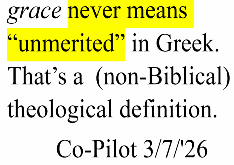

In #1 I have shared AI's Co-Pilot reasoning who I believe agrees with me. In #2 then I repeat my understanding of the Spirit's teaching on "grace."
1. ‘If
the Greek word charis [χάρις
translated usually as grace
or favor] means "unmerited" why is it used about
Jesus in Luke 2:51-52?’ Since I am neither a Greek scholar or authority (although I consider myself a student of Greek), this was my question to Copilot, 3/7/2026.
COPILOT
ANSWER:
Here’s
the key insight, Gaylon: charis never
actually means “unmerited” in Greek.
That’s a later theological definition, not a lexical
one. And once you see that, Luke 2:51–52 makes perfect
sense. (my emphasis, GW) Let’s
walk through it clearly and step by step.
What
charis Really Means in Greek In
classical Greek, Koine Greek, and even in the New Testament, the core
meaning of χάρις (charis) is: • favor • gracefulness
/ beauty • kindness • goodwill • that
which causes joy or delight It
can also mean: • a
gift • a
benefit • favor
shown But
“unmerited favor” is not a Greek definition. That
phrase comes from Reformation-era theology, especially
Protestant discussions of salvation. (again, my
emphasis, GW). So
when someone says “charis means unmerited,”
they’re giving a doctrinal* definition, not a linguistic one. * This means according to their denomination's creed book which the Bible says to not add to!(GW)
So
What About Luke 2:51–52? The
passage says Jesus: • increased
in wisdom • in
stature • and
in charis with God and people If
charis meant “unmerited favor,” the verse would be
impossible: • Jesus
is sinless • Jesus
is perfectly obedient • Jesus
is the beloved Son • Jesus
merits favor by His perfect righteousness But
Luke isn’t saying anything about “unmerited” favor. He’s
using charis in its normal Greek sense: “Jesus
grew in favor, goodwill, and relational grace with God and with
people.” This
means: • People
increasingly recognized His goodness • He
became admired, respected, and loved • His
relationship with the Father unfolded in visible ways as He matured • His
life radiated beauty, kindness, and divine favor Nothing
here implies sin or lack. It
simply describes His growth in human experience. 易
Why
Theology Later Added “Unmerited” When
Paul talks about salvation by grace, he emphasizes that: • humans
do not earn salvation • God’s
saving favor is freely given So
theologians coined the phrase: “Grace
is unmerited favor.” That’s
a theological definition, not a lexical definition. It
works well in Paul’s soteriology, but it does not define the
word charis in every context. ✨ Summary* • Charis
does not mean “unmerited.” • It
means favor, goodwill, kindness, beauty, graciousness, or a gift. • In
Luke 2:52, it simply means Jesus grew in favor with God and people. • The
“unmerited” idea comes from later theology, not from
Greek.
*
-This makes my point. To say that “grace” is
‘UNMERITED” favor is to insert man’s definition
into the Spirit’s text to us! Ephesians 2:8ff does not mean
“unmerited” as the theologians argue. It is added by
them.—Gaylon West
The arguments made for interpreting God's grace as “unmerited” are founded upon perversions of some texts. The argument claim is “GRACE” has different applications and “nuances” which “allow” for “unmerited” to be added to the word. I've perused around 160 verses in the King James translation. Actually, I only found two passages that the “faith only” crowd possibly use for this argument: one is in Romans and another is in Ephesians (listed above).
Note:
I have been severely criticized for insisting that the Bible use of
“grace” DOES
NOT MEAN
“UNMERITED.”
So I asked the computer’s “Co-pilot”:
My ADDED COMMENTS
ABRAHAM'S FAITH AND WORKS IN ROMANS and JAMES.
ALL SCRIPTURE IS INSPIRED BY THE SPIRIT. Paul does not say one thing and James says another as has been heard in classes and read in comments.
“All scripture is given by inspiration of God” (2 Timothy 2:16). They are inspired by God's Holy Spirit and we must not say the Spirit contradicts Himself.
2 Peter 1:21, “for the prophecy came not at any time by the will of man, but holy men of God spoke as they were moved by the Holy Spirit.” To claim that the prophets contradicted one another is to belittle the Spirit. This applies as well to the apostles and prophets of the New Testament: Ephesians 3:4,5, “so that, when you read, you can see my understanding in the mystery of the Christ,) which, in other generations, was not made known to the sons of men, as it is now revealed to his holy apostles and prophets by the Spirit.”
FAITH VERSUS DEAD WORKS. James 2:17, “So also faith by itself, if it does not have works , is dead.” Faith includes its own peculiar works
[“work”: ;ergon, action] or it is “dead.” But Abraham had faith. WAS his faith dead? Is the following contradicting James?
Romans 4:2f, “2 For if Abraham were justified by works, he hath whereof to glory; but not before God. 3 “ For what saith the scripture?
Abraham believed God, and it was counted unto him for righteousness. 4 Now to him that worketh is the reward not reckoned of grace, but of debt. [“work”:
ergon, action].
Grace has been redefined by some from a misinterpretation of the Romans letter. As a result, commentators are said to say that James contradicts Paul.
The question arises, does “grace” change its meaning because of the use of the context's “work” or “acts”? The nuance
of a word in any context can be influenced and modified by various factors but unless there is cause for a figurative meaning, a word's literal meaning should be accepted.
This means the dictionary definition must form the baseline understanding of the word. The surrounding words, sentences, and the situation in which the word is used significantly
shape its meaning in its context.* * https://www.merriam-webster.com/dictionary/nuance
In Romans' context “work” is used apparently by these commentators to “shape” grace. So, the question becomes, “What is the nuance of 'work' or 'act'” mentioned?”
“Work” (acts) used in this context plus the previous chapter is obeying the Old Testament Law commands. Abraham's actions preceded centuries the Law given through
Moses and during his lifetime preceded the law of circumcision. His faith in the context then was not amenable to those acts of the Mosaic Law.
CONTEXT: Romans 4's context continues from chapter 3 and is contrasting the type of work (act, doing) of the Old Testament Law (Romans 3:28) that the Jewish Christians wanted
to require of the Gentiles (for example, circumcision, in this context, Romans 3:1,2). The faith required for Abraham was in God's power to raise the dead and Abraham's trusted
that God delivers even at his age and his wife's Sarah's dead womb. This was prophetic of Jesus' resurrection. Abraham's faith overcame and negated his failed attempt in his act
to circumvent God's promise by using Sarah's maid to help God? (in the text).
There is no contradiction when we identify the actions or works of the context. Abraham's faith in obeying God's directive of the law of marriage as directed which obedient act
received God's grace or favor.
EPHESIANS AND FAITH. The Ephesians letter specifically requires good works as a result of submitting to the grace of God. But the use of faith in this passage is speaking of the
source of the grace. Grace is obtained through “the faith.” It is not in the act of simply believing but is obtained through “the” faith. The Greek has
the definite article just as Jude 3* does.
*JUDE 3 Beloved, when I gave all diligence to write unto you of the common salvation, it was needful for me to write unto you, and exhort you that ye should earnestly contend for
the faith which was once delivered unto the saints.
CONCLUSION
Words have been described as “trucks” for communication by teachers (according to the popular Adrian Rogers, a Southern Baptist pastor-preacher). The truck has to deliver
the correct definition or otherwise, communication is broken down. The word "grace" means simply "favor". To add or change the meaning is adding to the message, the word of God.
After discovering the common definition of grace, especially as “favor” with its synonyms of “favor” in Greek and Hebrew dictionaries, the common tendency
is to tack on the descriptive term “unmerited” as an “modifier” by expositors. This is claimed as being required by its use in such passages as Ephesians 2:8-10
and Romans 4:2-8. However, a closer look at these passages rejects the definition.
The use of “grace” in Romans 4:2-8 includes the obedience to the “law of faith” (Romans 3:27 in context). Ephesians 2:8-10 tells us the “grace” is
obtained through the belief system (“the faith”, cf. Jude 3).